

Help for
grassroots
candidates

WHAT we HELP CAMPAIGNS DO
Message and strategy
We build the case for your candidacy: who you are, why you are running, and why the voters you need should believe you. You leave with a message that fits you and holds up when the race gets hard.
Building campaign structure
A campaign is not just a candidate and a message, its an organization, and it needs a legal and operational structure to survive. Election law sets rules you have to follow, from how you register your campaign to how you file. Campaign finance law adds its own rules: you have to register a committee, name a treasurer, track every dollar in and out, and report it all on a fixed schedule. Miss a deadline or break a rule, and the story becomes your paperwork instead of your platform. A late report can bring fines. A committee you never set up can mean the end to your campaign.
A well-funded campaign has lawyers and accountants for this. A grassroots candidate usually doesn’t, and the work still has to get done. I help you build the structure a real campaign needs: the committee, the treasurer, the systems that keep your money, your volunteers, and your voter contact organized, and the calendar that keeps you ahead of every deadline. Done right, none of it shows. It just means you never lose the race on a technicality.
Strategic and operational planning
Strategy is the plan to reach the number of votes you need: who your voters are, what will move them, and the message that carries it. Operations is how that plan runs day to day: the budget, the calendar, the fundraising, and the field work that puts your message in front of voters. We build both, backward from election day, and sized to what you actually have. You leave with a plan you can run, not a binder you file away.
Readiness for a run
If you’re still deciding, we work through what a run actually takes, so you go in with your eyes open and a plan instead of a hunch
Voter outreach
We design an outreach plan around how real communities decide who to trust and how they communicate, so your limited time and money reach the people who can actually move your race.
Start with the field guide
Before you hire anyone, you can arm yourself. On the Ballot is the guide I wish every first-time candidate had. It covers the nuts and bolts of getting on the ballot and running a credible race without a party operation behind you, whether you’re running for a federal seat, a statewide office, or a spot on your city council or school board. It walks you through filing requirements, petitions and signatures, deadlines, and the early decisions that determine whether a campaign qualifies to get on the ballot. It shows you exactly where to find the rules for your own race, so you are never guessing at the requirements where you live.
It will not run your campaign for you, but it will make sure you avoid the pitfalls that end campaigns before they start.
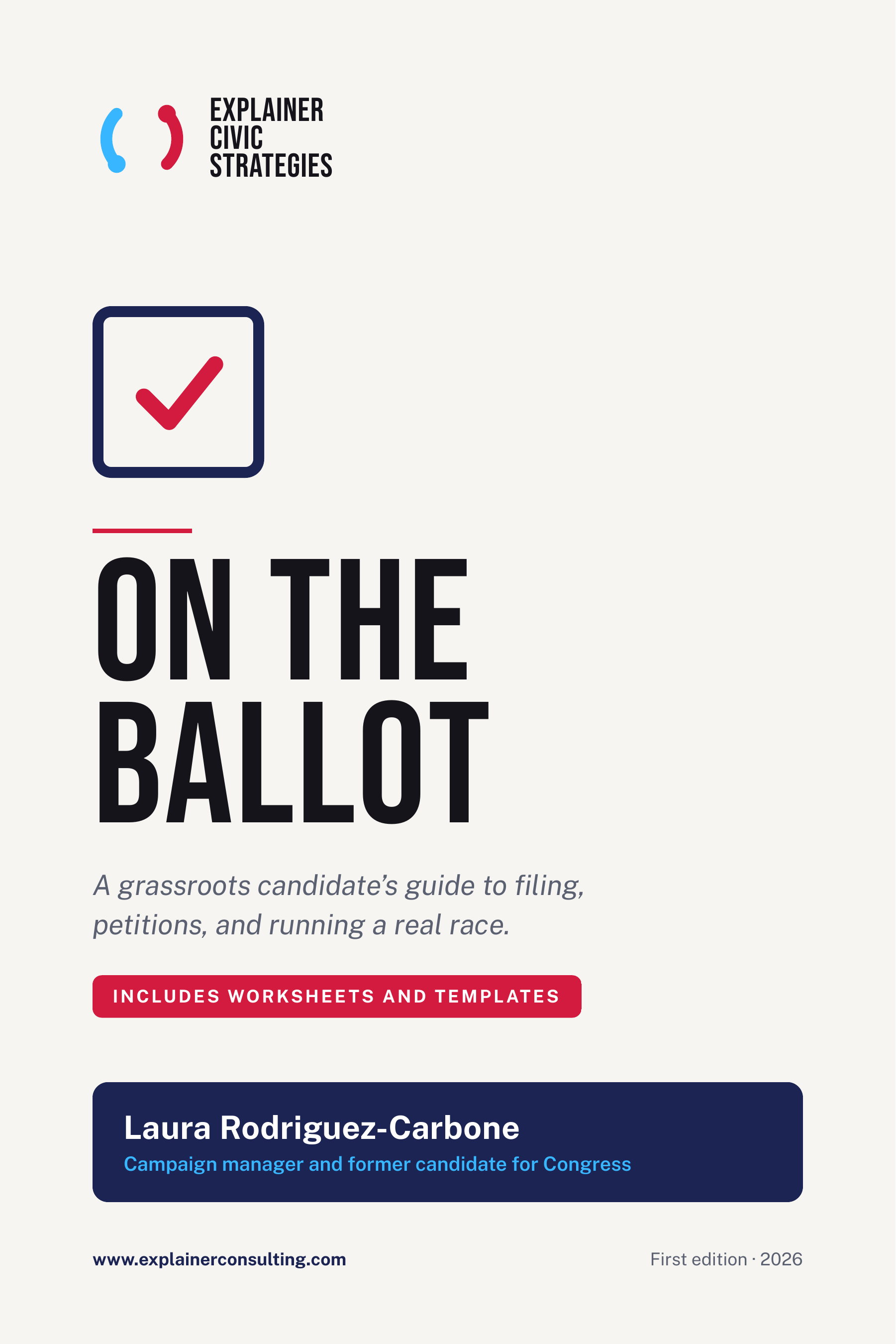
The Guide Every First-Time Candidate Wishes They Had
On the Ballot walks grassroots candidates through filing, petitions, deadlines, and campaign finance, and comes with worksheets you can use the day you open them. You don’t need a party's permission to run. But, you do need to get the fundamentals right, and not doing that is where good candidates gets stopped before they start. Not on the issues, on the paperwork. A petition turned in a few signatures short; a board of elections that invalidates signatures; a filing deadline missed by a day; a committee that was never registered. All of those things can disqualify you from getting on the ballot. This guide exists to make sure that’s less likely to happen to you.
On The Ballot is written by Laura Rodriguez-Carbone, who has managed congressional and city council campaigns, worked races at every level, and run for Congress herself in Ohio's 7th District. This is not advice from a publisher or an anonymous expert. Its the conversation she would have with a friend who called and said they were thinking about running for office.
This e-book is built to use, not just read. On the Ballot comes with a full set of worksheets and templates: a filing checklist, a petition and signature tracker, a campaign calendar, a starter budget, an eligibility check, and a page of the exact questions to ask your board of elections.
Get on the ballot the right way, and give yourself a real chance to win!
What's Inside
A plain-language guide to filing, petitions, deadlines, and campaign finance
How to find and confirm the rules for your own race, at any level
A filing checklist and eligibility self-check
A petition and signature tracker
A campaign calendar worksheet
A starter budget template
The exact questions to ask your election authority
The reality is, most campaign help is built for party-backed candidates. Explainer Civic Strategies is built for everyone else. If you have the drive to run but not the institutional backing to help you get on the ballot, Explainer Civic Strategies can help.
I’ve managed congressional and city council campaigns, worked national, state, and local races as a strategist, and run for federal office myself in Ohio's 7th District. I know this work from both the manager and candidate side. I know what it takes to stretch resources without a donor list handed to you. I can build a field program from nothing, and help you understand how to ask people to believe and your message. Grassroots candidates are not running a smaller version of a machine campaign. They are running a different kind of race, and it needs a different kind of strategy.
when you want a strategist in your corner
Getting your name on the ballot is only the beginning. What comes next is a run of hard choices, and most first-time campaigns struggle because they make those choices on instinct instead of a plan. Who are the voters who will actually decide this race, and how do you reach them with the time and money you have? What is your message, and does it hold up when your opponent pushes back? Where do you spend your first dollar and your first volunteer hour? A well-funded campaign has a team to answer those questions. A grassroots campaign usually doesn’t.
I have done this from both sides and know how to build a message that fits you, find the voters who can move your race, and put what you have where it matters most. I also know what it takes to do all of that with far less money than other candidates have.
If you want a partner who has both run these races and managed them, book a consultation. Tell me about your race, what you are up against, and what you’re trying to build.